


In current minds, companies are often faced with the need to invest in hardware, software and infrastructure solutions. The choice of the method of financing is no less important than the choice of the product itself. This is where business strength, financial stability, financial stability and long-term efficiency come into play.
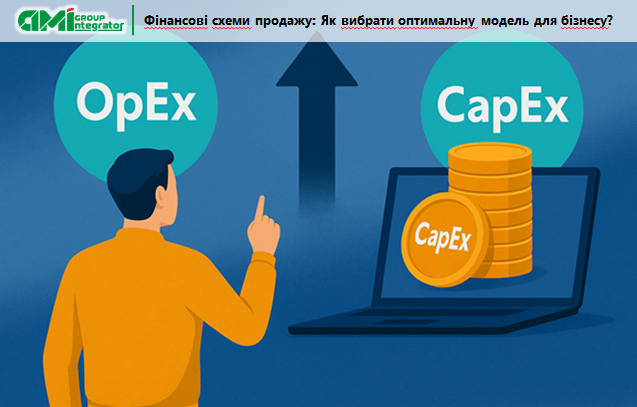
The two broadest financial models are: OpEx (operational expenses, rent) and CapEx (capital expenses, re-stitching / purchase). Each of them has its own advantages and is suitable for different types of companies and different strategic goals.
OpEx: flexibility and transferability of losses.
The OpEx model is becoming increasingly popular, especially among companies that require rapid adaptation to market changes. Its key feature is the ability to acquire ownership or software without significant start-up investments.
Key advantages:
CapEx: power and long-term savings.
The CapEx model is optimal for companies that want to invest in assets and lock them in for themselves. This is an approach for a stable business with long-term needs.
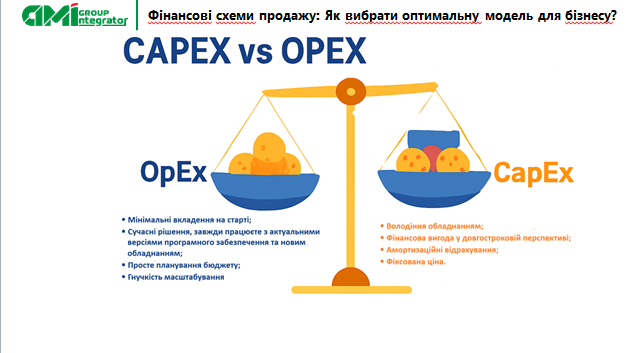
Key advantages CapEx:
Comparing OpEx and CapEx: What to Choose?
The choice of model depends on the company's development strategy, level of financial stability, and business processes.
| Criterion | OpEx (rental) | CapEx (installment/purchase) |
| Початкові інвестиції | Minimum | Minimal, but higher than when renting |
| Asset ownership | No, only access for the duration of the rental | Yes, after the payments are completed |
| Flexibility | High – easy to scale | Low – assets are secured |
| Relevance of solutions | Always new hardware and software | Possible gradual obsolescence |
| Budgeting | Regular equal payments | More complex planning |
| Tax benefits | Expenses are written off as current | Depreciation reduces the tax base |
| Risks | Depends on rental terms | Obsolescence risks and service costs |
| Financial perspective | Convenient for short- and medium-term projects | Beneficial for long-term use |
The optimal financial model depends on the strategic goals and stage of business development. OpEx provides flexibility and predictability, while CapEx provides control and long-term benefit.
Companies seeking to effectively manage costs and investments are increasingly combining both models, adapting them to different areas of activity.